Currently Empty: $0.00
Why Forklift Gear Ratios Matter for Loaded and Unloaded Travel
Gear ratios rarely get much attention when buyers compare forklifts, yet they quietly shape how well a machine moves both empty and under a heavy load. The right gearing lets a forklift pull away smoothly with a full load, climb a ramp without strain, and travel efficiently when it runs empty. Get it wrong, and the machine feels sluggish under load or works its engine too hard on the move. Understanding how gear ratios affect pulling force and travel speed helps you appreciate what makes a forklift dependable across the full range of daily work. This guide explains why forklift gear ratios matter for loaded and unloaded travel, so you can judge a machine by how it actually performs.
How Gear Ratios Affect Forklift Pulling Force
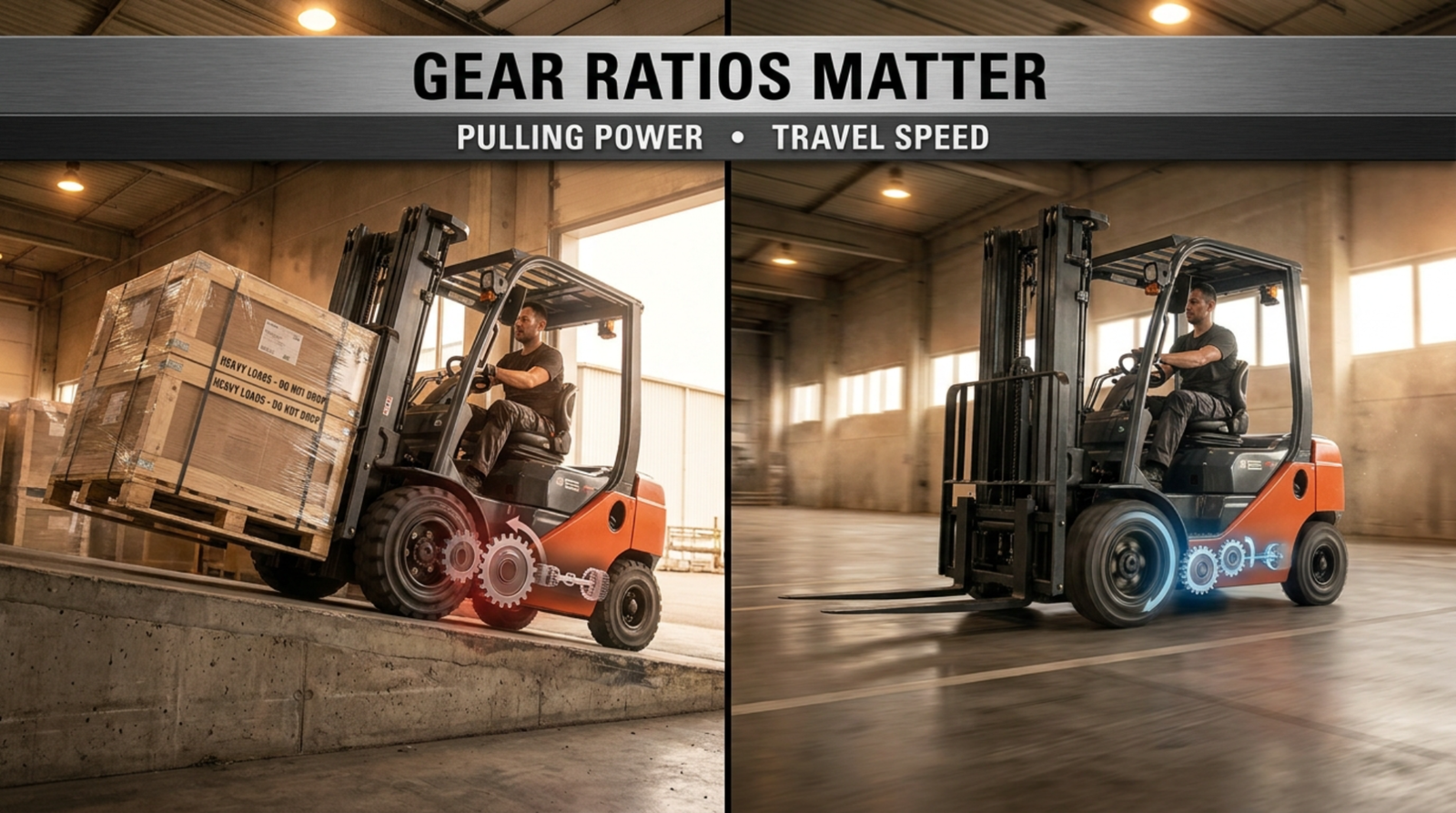
Gear ratios are the mechanism that converts engine output into the pulling force a forklift needs at its drive wheels, and the relationship is direct. A lower gear ratio multiplies the torque delivered to the wheels, giving the machine the strength to move heavy loads from a standstill. Starting a loaded forklift from rest demands a great deal of force, because the machine has to overcome the inertia of both its own weight and the load on the forks. Lower gearing supplies exactly that force, letting the drive wheels apply the torque needed to get everything moving in a controlled, confident way.
This torque multiplication matters most in two common situations. The first is accelerating with a loaded truck, when the combined mass resists movement and the drivetrain must work hardest to build speed from zero. The second is traveling on an incline, where the machine fights gravity in addition to its own weight and load. On a ramp, a forklift without adequate pulling force can stall, slip, or struggle to keep moving, which is both unproductive and unsafe.
Lower gear ratios help the forklift handle these demands in several ways:
- Moving heavy loads from a standstill, where the torque to overcome inertia is greatest.
- Accelerating with a loaded truck, where combined mass resists a smooth start.
- Climbing inclines, where the machine must overcome gravity along with its load.
When the gearing delivers strong torque at the drive wheels, the forklift pulls away steadily rather than laboring against the load. That dependable pulling force is the foundation of confident loaded travel, giving the operator control from the very first moment the machine begins to move.
Why Loaded Forklifts Need Different Drive Characteristics
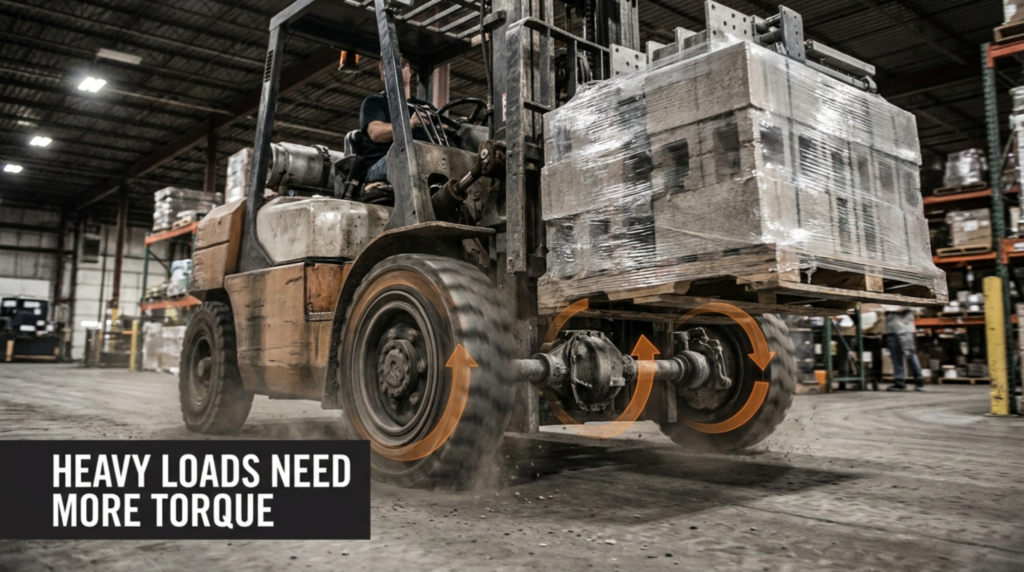
A loaded forklift behaves very differently from an empty one, and the reason comes down to mass. When a heavy load sits on the forks, the machine’s total weight rises considerably, which increases the force required both to accelerate from a stop and to maintain movement once underway. The drivetrain has to work noticeably harder to move that greater mass, and the gearing plays a central role in whether it does so smoothly or with strain. Appropriate gearing is what allows the drivetrain to deliver usable torque to the wheels without overworking the engine and transmission.
The concern here is not only performance but the health of the machine. If a forklift is asked to move heavy loads without the gearing to supply the needed torque, the engine and transmission absorb excessive stress as they compensate. That strain generates heat, accelerates wear, and shortens the life of components that are expensive to repair. Correct gearing spreads the work sensibly, so the drivetrain provides the force the load demands while each component operates within a comfortable range.
Consider what appropriate gearing does for a loaded machine:
- Delivers usable torque to move the greater mass from a standstill and keep it moving.
- Protects the engine from working near its limit every time the machine carries a load.
- Reduces transmission strain, preserving durability across repeated loaded cycles.
Because a loaded forklift places such different demands on the drivetrain, its drive characteristics must be matched to that reality. A machine geared to handle its rated load moves heavy weight confidently and consistently, without punishing its own components in the process. This matching of gearing to load is what keeps a forklift both capable and durable through the demanding, repeated work that loaded travel involves day after day.
How Higher Gears Improve Unloaded Travel
Not every trip a forklift makes involves a heavy load. Machines frequently travel empty or lightly loaded, whether returning for the next pallet or repositioning across a facility, and these conditions call for very different gearing. When the forklift carries little or no load, far less wheel torque is needed to accelerate and keep moving, because there is far less mass to overcome. In this situation, the low gearing that helps under a heavy load is no longer necessary, and higher gears become the more sensible choice for efficient travel.
Higher gears trade some torque multiplication for greater travel speed, which suits unloaded movement perfectly. With little load to move, the machine does not need maximum pulling force, so it can take advantage of higher gearing to travel faster and cover ground more quickly. This makes empty trips more efficient, cutting the time spent moving between tasks and keeping the overall work cycle productive. An operator returning for another load benefits directly from a machine that travels briskly when unburdened.
There is an efficiency benefit for the engine as well. Higher gears allow the machine to reach greater speeds while keeping engine operation within a suitable range, rather than forcing the engine to run harder than the light workload requires. This keeps fuel or energy use sensible and avoids unnecessary wear during the many empty trips a forklift makes over a shift. In practical terms, the ability to shift into higher gearing for unloaded travel means the machine is not wasting effort. It moves quickly and efficiently when speed matters more than force, then has the lower gearing available again when a load returns. That adaptability across conditions is what makes a forklift genuinely productive throughout the working day.
The Balance Between Torque and Travel Speed
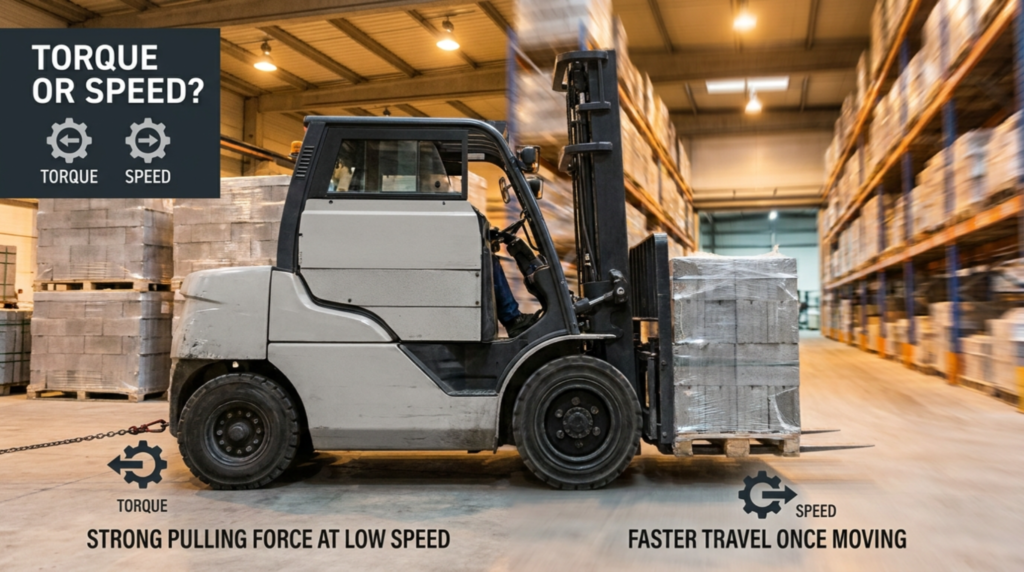
At the heart of forklift gearing lies a fundamental trade-off, and understanding it explains why no single gear ratio suits every situation. Gearing must balance pulling force against travel speed, because the two work against each other. Lower gears prioritize torque, supplying the strong pulling force and controlled movement needed to handle heavy loads and start from a standstill. Higher gears prioritize speed, allowing faster travel once the machine has momentum behind it. A forklift cannot maximize both at the same time, so its gearing is designed to provide the right characteristic for each set of conditions.
This trade-off reflects the different demands a forklift faces through its work. When moving a heavy load or setting off from rest, torque is what matters, and lower gears deliver the force and precise control the task requires. Controlled movement is especially valuable when handling loads, since it lets the operator place and maneuver weight carefully rather than lurching or straining. Once the machine is up to speed, particularly when running light, the priority shifts toward covering distance efficiently, and higher gears provide that faster travel.
The key distinction comes down to two priorities:
- Lower gears favor torque and controlled movement for heavy loads and starting from a standstill.
- Higher gears favor faster travel once sufficient momentum has been established.
A well-designed forklift makes this balance work in the operator’s favor, providing strong pulling force when the load demands it and higher travel speed when conditions allow. Rather than forcing a compromise that serves neither need well, thoughtful gearing gives the machine the right blend of force and speed for the moment. That balance between torque and travel speed is what lets a forklift move heavy loads with confidence and still travel efficiently when the work calls for pace.
Why Proper Gear Selection Improves Forklift Performance
Everything about how a forklift drives comes back to how well its gearing matches the work, which is why proper gear selection has such a clear effect on performance. A well-matched gear ratio helps the machine respond appropriately in both loaded and unloaded conditions, giving it strong pulling force when carrying weight and efficient speed when running light. Because a forklift moves between these conditions constantly through a shift, gearing that suits both is what allows the machine to perform dependably no matter what the moment requires.
The benefits of correct gear selection show up across several areas of performance. Acceleration improves, because the machine can build speed smoothly whether it is starting a heavy load or pulling away empty. Drivability improves too, since the forklift responds predictably to the operator, feeling controlled under load and lively when unburdened. Efficiency benefits as well, because gearing matched to the conditions avoids wasting engine effort, keeping fuel or energy use sensible across both loaded and unloaded travel.
Proper gear selection supports the machine in ways worth noting:
- Acceleration that stays smooth and confident under load and when empty.
- Drivability that gives the operator predictable, controlled response in all conditions.
- Efficiency that keeps engine effort and energy use sensible across the work cycle.
- Drivetrain durability that protects the engine and transmission from unnecessary strain.
Durability deserves particular attention, because gearing that matches the load keeps the engine and transmission working within a comfortable range rather than straining to compensate. That reduced stress preserves these components over the long term, lowering the risk of premature wear and costly repair. When all these benefits come together, the result is a forklift that accelerates well, drives predictably, runs efficiently, and lasts. Proper gear selection, then, is not a minor technical detail but a defining factor in the reliable, capable performance that demanding material handling depends on.
Conclusion
Gear ratios shape how a forklift performs across every part of its working day, even though they seldom get the attention that lifting capacity or fork length receive. Lower gears multiply torque at the drive wheels, giving the machine the pulling force to move heavy loads from a standstill and climb inclines with confidence. A loaded forklift, with its far greater mass, depends on appropriate gearing to deliver that torque without straining the engine and transmission. Higher gears, meanwhile, let the machine travel efficiently at greater speeds when it runs empty. All of this reflects a careful balance between pulling force and travel speed. When the gearing is matched well to both loaded and unloaded conditions, the forklift accelerates smoothly, drives predictably, runs efficiently, and protects its own drivetrain, delivering the dependable performance that reliable material handling demands.
Frequently Asked Questions
1. How do gear ratios affect a forklift’s pulling force?
Gear ratios convert engine output into the pulling force delivered at the drive wheels, and lower gear ratios multiply that torque. This gives the forklift the strength to move heavy loads from a standstill, which requires a great deal of force because the machine must overcome the inertia of both its own weight and the load on the forks. Lower gearing matters most in two situations: accelerating with a loaded truck, where combined mass resists a smooth start, and traveling on an incline, where the machine fights gravity as well as its load. Without adequate pulling force on a ramp, a forklift can stall, slip, or struggle to keep moving. Strong torque at the drive wheels lets the machine pull away steadily and confidently rather than laboring against the load.
2. Why does a loaded forklift need different drive characteristics than an empty one?
A loaded forklift has significantly greater total mass than an unloaded one, which increases the force needed both to accelerate from a stop and to maintain movement. The drivetrain has to work noticeably harder to move that added weight, and appropriate gearing is what allows it to deliver usable torque without overworking the engine and transmission. This matters for both performance and durability. If a machine is asked to move heavy loads without the gearing to supply the needed torque, the engine and transmission absorb excessive stress as they compensate, which generates heat, accelerates wear, and shortens component life. Correct gearing spreads the work sensibly, so the drivetrain provides the force the load demands while each component operates within a comfortable range, keeping the machine both capable and durable.
3. How do higher gears help when the forklift is traveling empty?
When a forklift carries little or no load, far less wheel torque is needed to accelerate and keep moving, because there is much less mass to overcome. In these conditions, higher gears become the sensible choice. They trade some torque multiplication for greater travel speed, which suits unloaded movement well, letting the machine travel faster and cover ground more quickly. This makes empty trips more efficient, cutting the time spent moving between tasks and keeping the overall work cycle productive. Higher gears also allow the machine to reach greater speeds while keeping engine operation within a suitable range, rather than forcing the engine to run harder than the light workload requires. That keeps fuel or energy use sensible and reduces unnecessary wear during the many empty trips a forklift makes over a shift.
4. What is the trade-off between torque and travel speed in forklift gearing?
Forklift gearing involves a fundamental trade-off, because pulling force and travel speed work against each other and no single gear ratio can maximize both. Lower gears prioritize torque, supplying the strong pulling force and controlled movement needed to handle heavy loads and start from a standstill. Controlled movement is especially valuable when handling weight, since it lets the operator place and maneuver loads carefully rather than lurching. Higher gears prioritize speed, allowing faster travel once the machine has established sufficient momentum, which suits unloaded or light travel. A well-designed forklift makes this balance work in the operator’s favor, providing torque when the load demands it and speed when conditions allow. That thoughtful blend of force and speed is what lets a forklift move heavy loads confidently and still travel efficiently when pace matters.
5. Why does proper gear selection improve overall forklift performance?
A well-matched gear ratio helps the forklift respond appropriately in both loaded and unloaded conditions, giving it strong pulling force when carrying weight and efficient speed when running light. Because the machine moves between these conditions constantly, gearing that suits both is what allows dependable performance throughout the day. Proper gear selection improves acceleration, letting the machine build speed smoothly whether loaded or empty, and it improves drivability, so the forklift responds predictably to the operator. It also supports efficiency, since gearing matched to the conditions avoids wasting engine effort and keeps energy use sensible. Just as importantly, it protects drivetrain durability by keeping the engine and transmission working within a comfortable range rather than straining to compensate. Together, these benefits produce a forklift that accelerates well, drives predictably, runs efficiently, and lasts.